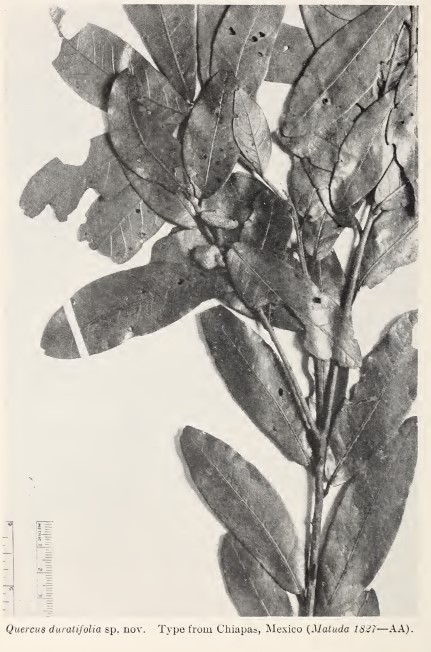
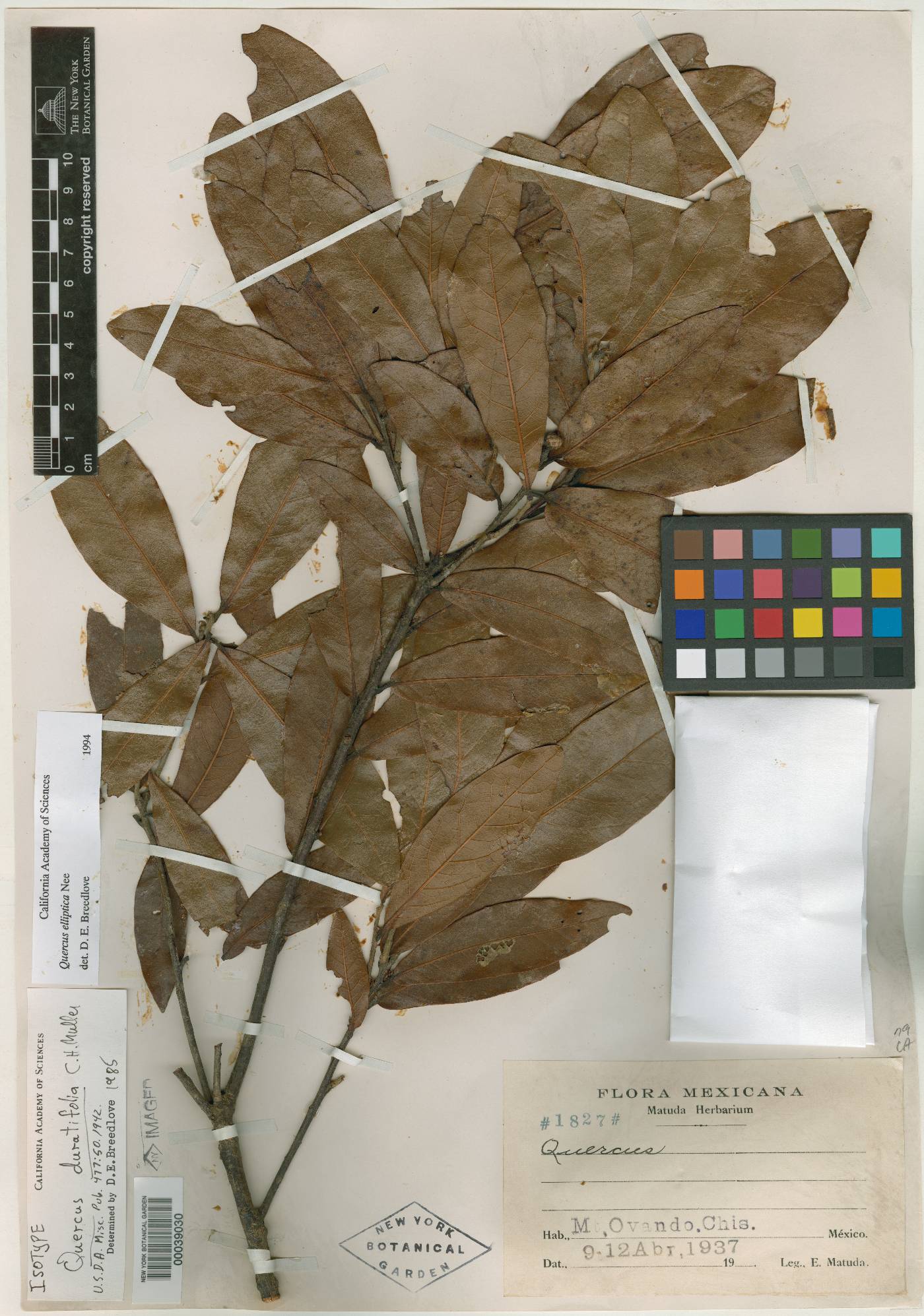
| Quercus salicifolia | |
| Author | Née 1801 Anales Ci. Nat. 3: 265 |
| Synonyms | acapulcensis Trel.
1924 diagnose ICI chiriquensis Trel. ex C.H.Muller 1942 duratifolia C.H.Muller 1942 (A.Camus : n° 330) mexicana var. glabrata Liebm. ex Seem. 1856 mulleri Martinez 1953 Anales Inst. Biol. Univ. Nac. México 24: 51 1953. tahuasalana Trel. 1924 |
| Local names | encino saucillo; |
| Range | Mexico, in the Sierra Madre del Sur, Pacific slope (Chiapas, Colima, Guerrero, Jalisco, Michoacan, Oaxaca, Puebla, Querretaro); Costa Rica, Guatemala, Honduras, El Salvador, Panama, Nicaragua ; 100-1250 m ; |
| Growth habit | 12-25 m, and more; trunc cylindrical to 60 cm in diameter; dense rounded crown; |
| Leaves | 7-15 x 2-4 cm; deciduous; coriaceous; oblanceolate, lanceolate or elliptic; 3.6 to 4.9 times as long as wide; apex pointed, acuminate, aristate; base narrowly rounded or cuneate; margin thick but not revolute, entire; adaxially smooth, dark glaucous green, shiny, hairless; abaxially paler, slightly glaucous, smooth, hairless except some fasciate hairs at axils; 12-22 veins pairs, not quite parallel, often curved, ascending at an angle of 45° with midrib, slightly raised beneath, yellowish; epidermis smooth, papillose, not bullate; petiole 3.4-4 mm long, pinkish, glabrescent; |
| Flowers | from December to January; male catkins 4-6 cm long, few flowered; female flowers 1-4 on a 0.2-0.8 cm long rachis; |
| Fruits | acorn 1-1.6 cm long, 0.8-1.2 cm wide, ovoid, mucronate, yellowish pubescent, shiny brown; solitary or paired on a 1 cm long peduncle; pericarp pubescent inside; cup halfround or less deep, 1.5-2 cm in diameter, with pointed scales, enclosing 1/4 or 1/3 of nut; maturing same year; |
|
Bark, twigs and |
bark smooth or slightly rough, yellowish grey to nearly black, with vertical ridges and horizontal fissures; twigs slender, 1-2.5 mm thick, dark pinkish brown, glabrescent; conspicuous light, 0.5-1 mm long lenticels; bud ovoid, pointed, 1.5-5 mm long, dark reddish brown, with silky scales sometimes ciliate; deciduous stipules 5 mm long; |
| Hardiness zone, habitat | hardy zone 8; slow growing; wet forests in mountains; |
| Miscellaneous |
-- A. Camus n° 405; -- Resembles Q. pinnativenulosa, but this one is long acuminate with a bristle-tipped apex often curly, acorns maturing in 2 years, hairless leaves without any shade of glaucous, a cuneate base, a longer petiole; see HERE to compare with other whole-leaved oaks -- Q. mulleri, true species for the Plant List 2013, could be a variant to 20 m tall, with leaves light green somewhat glaucous, narrowly lanceolate, often falcate, long acuminate, with 25-30 veins pairs at an angle of 60° with midrib; acorn 1.7 cm long, with a short peduncle, and a turbinate, 1 cm long for 0.7 cm high cupule; the cup-scales are oval and smooth; in Mexico it is endemic in the Sierra del Sur (Oaxaca); IUCN Red List category CR) but is not currently protected; -- For Susana Valencia 2004, Q. duratifolia is a true species, but not for J.L. Linares 2006 (El Salvador), neither for POWO. -- For Bartholomew & Almeda 2023, the synonymy for Q. salicifolia is only Q. acapulcensis and Q. tahuasalana.
|
| Subspecies and varieties |
|
| Pictures |
|